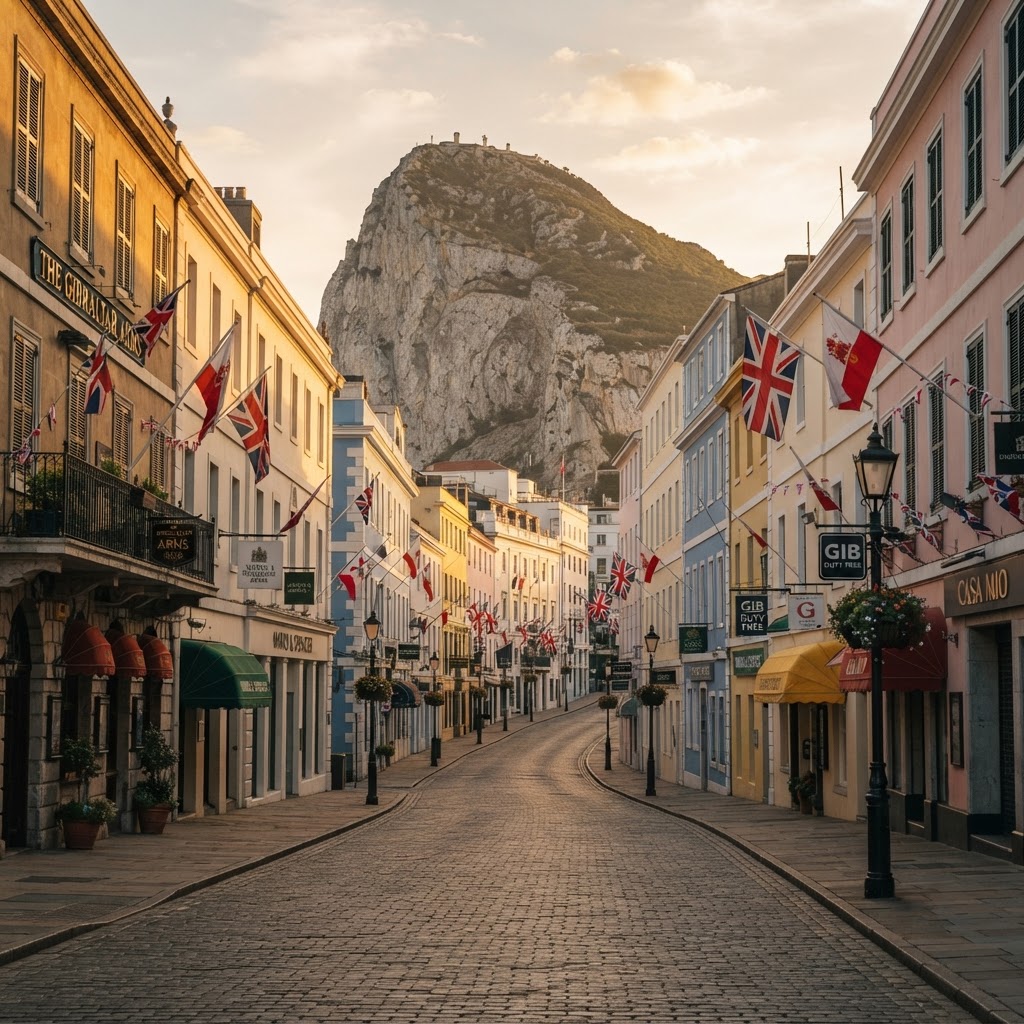
☀️ Gibraltar heat warning — stay safe on the Rock
Summer temperatures regularly exceed 30°C with high humidity. Follow local advice, stay cool and hydrated, carry water (refill free at Casemates Square), avoid the Upper Rock between 12:00–16:00, and use sun protection (hat, sunglasses, SPF 30+). If you feel dizzy or stop sweating, seek shade and fluids immediately.
Full guide: How to cool down in Gibraltar →Key takeaways
- 1.The Rock That Changed History In the spring of 711 AD, an Arab-Berber force of around 7,000 men crossed the Strait of Hercules and landed on a limestone promontory jutting from the southern tip of Iberia.
- 2.Their general, Tariq ibn Ziyad, gave his name to the Rock: Jabal Tariq — the Mountain of Tariq — which became, over centuries of linguistic evolution, Gibraltar .
- 3.What followed was one of the most significant military campaigns in European history.
The Rock That Changed History
In the spring of 711 AD, an Arab-Berber force of around 7,000 men crossed the Strait of Hercules and landed on a limestone promontory jutting from the southern tip of Iberia. Their general, Tariq ibn Ziyad, gave his name to the Rock: Jabal Tariq — the Mountain of Tariq — which became, over centuries of linguistic evolution, Gibraltar.
What followed was one of the most significant military campaigns in European history. Within a decade, the Moorish forces had swept through virtually the entire Iberian Peninsula, reaching as far north as the Pyrenees and briefly crossing into France before being halted at the Battle of Tours in 732. Gibraltar, as the gateway between Africa and Europe, became the lynchpin of this empire.
For the next 750 years, Gibraltar was an Islamic territory — part of the vast cultural and intellectual civilisation of Al-Andalus, which produced breakthroughs in mathematics, astronomy, medicine, philosophy, and architecture that would eventually fuel the European Renaissance.
Tariq ibn Ziyad: The Man Who Crossed the Strait
Tariq ibn Ziyad was a Berber general serving the Umayyad Caliphate, under the command of Musa ibn Nusayr, governor of North Africa. His crossing in April 711 was ostensibly invited by Roderic's political opponents within Visigothic Iberia — but whatever the pretext, the military conquest that followed was swift and decisive.
The Visigoths, who had ruled Iberia since the fall of Rome, were defeated at the Battle of Guadalete (near modern Jerez de la Frontera) in July 711. King Roderic was killed. Within three years, most of the peninsula was under Moorish control.
Gibraltar served as the bridgehead — the fortified base from which the conquest was launched and supplied. Tariq himself is said to have camped on the Rock before marching north. The cave now known as St Michael's Cave was reputedly used as a military storage site during these early years.
The Moorish Castle: Gibraltar's Most Visible Legacy
The most prominent surviving monument from the Moorish period is the Moorish Castle — or more accurately, the Tower of Homage (Torre del Homenaje) that crowns the castle complex. The tower dates from the 14th century, built during the Nasrid dynasty that also constructed the Alhambra in Granada, but it stands on foundations that go back to the earliest days of Islamic Gibraltar.
The castle served multiple functions over 750 years: a royal residence, military garrison, prison (it later held French prisoners during the Napoleonic Wars), and — above all — a symbol of Islamic power visible from the sea and from Spain. To stand at its base today and look across to the Spanish coast is to understand immediately why Gibraltar mattered strategically.
The Tower of Homage is open to visitors as part of the Upper Rock Nature Reserve. Its distinctive Islamic-style battlements — including the decorative horseshoe arches that echo Moorish architecture across Spain — are among the finest examples of medieval Islamic military architecture in the British Isles.
Al-Andalus: The Civilisation That Shaped Medieval Europe
To understand Moorish Gibraltar, you must understand Al-Andalus — the name given to the Islamic territories of Iberia. At its height, Al-Andalus was the most sophisticated civilisation in Western Europe by a considerable margin. While much of Christian Europe endured the Dark Ages, the cities of Cordoba, Seville, and Granada were centres of learning, commerce, and artistic achievement.
- Córdoba was the largest city in Europe in the 10th century — with a population approaching 500,000, a public library of 400,000 volumes, and street lighting centuries before London or Paris.
- Arabic numerals — the number system we use today — were transmitted to Europe through Moorish Iberia. So was algebra, algorithms, and much of classical Greek philosophy (preserved and expanded by Arab scholars).
- Medicine: Ibn Rushd (Averroes), born in Córdoba, wrote medical and philosophical texts that became standard references in European universities for centuries.
Gibraltar was a trading port and strategic garrison within this civilisation — relatively small, but vitally positioned at the gateway between the Atlantic and the Mediterranean, and between Africa and Europe.
The Great Sieges of the Moorish Period
Gibraltar did not sit peacefully under Moorish rule for 750 years. The Rock was contested repeatedly as Christian kingdoms to the north — Castile, León, Aragon — pushed southward in the campaign known as the Reconquista.
First Christian Capture (1309)
In 1309, a Castilian force under Alonso de Guzmán — the same family whose ancestor gave his name to the Castillo de Guzmán in Tarifa — captured Gibraltar from the Moorish Marinid dynasty. The Christian occupation lasted only 24 years: in 1333, the Marinids retook the Rock after a siege and held it for the next 130 years.
The Final Reconquest (1462)
On 20 August 1462, Gibraltar was taken by Castilian forces under the Duke of Medina Sidonia and formally ceded to the Spanish Crown. The last Moorish governor departed, and 750 years of Islamic rule ended. The date — the Feast of Saint Bernard — is still commemorated in Gibraltar today.
What the Moors Left Behind
Beyond the castle, the Moorish period left deep marks on Gibraltar that persist to this day:
- The name itself — Jabal Tariq, Gibraltar. Every time the Rock's name is spoken, Tariq ibn Ziyad is commemorated.
- Cisterns: The Moorish water cisterns carved into the Rock provided Gibraltar's water supply for centuries. You can see examples near the Moorish Castle.
- Street layout: Parts of the old town around Castle Road and the upper slopes follow the original Moorish street pattern.
- The Upper Rock tunnels: While the famous Great Siege Tunnels date from the 18th century, some of the Rock's internal passages have Moorish origins.
- Place names: Several Gibraltar street and area names have Arabic or Moorish derivations, preserved through centuries of linguistic change.
Visiting Moorish Gibraltar Today
The best way to connect with Gibraltar's Moorish heritage is through a visit to the Moorish Castle and Tower of Homage, accessible via the Upper Rock Nature Reserve. The Historical Sites section of Gibraltar Unlocked covers this and other key heritage sites in detail.
The Gibraltar Museum on Bomb House Lane (town centre) has an excellent permanent exhibition on the Moorish period, including architectural models of the castle as it would have appeared in the 14th century and artefacts from the Islamic era. Entry is around £2 — one of the best-value attractions on the Rock.
For the full picture of Gibraltar's extraordinary layered history — from Neanderthals 40,000 years ago through Phoenicians, Romans, Moors, Spanish, and British — explore our Insights & History section.
Enjoying this guide?
Get the best of Gibraltar in your inbox each week — tips, new spots, and events. No spam, unsubscribe anytime.
Explore more on Gibraltar Unlocked
Daniel Toledo
FounderGibraltar-based writer and founder of Gibraltar Unlocked. Covering local food, travel, history and life on the Rock since 2023. Also builds web apps at instatales.ai.